How I Paid Off $10,000 in 18 Months on an Ordinary Salary
No inheritance. No side hustle empire. No viral moment. Just one plan, one spreadsheet, and eighteen months of stubbornness. Here is exactly how it happened.
The number I keep coming back to is not the $10,000. It is the first one. $700. That was the store card. And clearing it in about six weeks is the moment everything changed.
But let me start at the beginning, because the beginning is where most people are right now.

Where it started: $10,000 across four debts
The moment I finally stopped avoiding it and wrote everything down, this is what I was looking at:
| Debt | Balance | Rate | Minimum |
|---|---|---|---|
| Store card | $700 | 26% | $35 |
| Credit card | $2,300 | 21% | $60 |
| Personal loan | $3,000 | 14% | $95 |
| Car loan | $4,000 | 8% | $150 |
Ten thousand dollars. Four separate "I will deal with it later" decisions. The minimum payments alone were $340 a month. After some honest accounting I figured out I could find an extra $260 a month, which gave me a total monthly payment of about $600.
I chose the snowball. The store card was also my smallest balance, so the two methods agreed on where to start. But I chose snowball deliberately because I had tried to get out of debt twice before and quit both times. I needed wins more than I needed optimum interest savings.
Months 1 and 2: the first win
I threw everything at the $700 store card. It was gone before the end of month two. I still remember the exact moment I saw that balance read zero. It sounds small. It was not small. It was the first time in years that a debt had actually disappeared instead of just getting worse.
That feeling is the engine of the whole method. And it is why I did not start with the bigger targets.
Months 3 to 7: rolling the snowball
Here is where the method earns its name. The $35 I had been paying on the store card rolled straight onto the credit card. So instead of $60 a month on the credit card, I was now paying $635. The $2,300 balance that would have taken years on minimums was gone by month seven.
Two down. And now I had an even bigger payment to roll forward.
Months 8 to 13: the hard middle
This is the part nobody posts about. The personal loan was $3,000. Even with my now much larger payment rolling in, it took months to clear. There were no exciting wins for a while. Just the same payment, every month, watching a big number come down slowly.
I leaned hard on the tracker through this stretch. I opened it constantly, moved numbers around, watched the date hold steady. Momentum you can see is what carries you when you cannot feel it.
The personal loan cleared around month thirteen. Three down.
Months 14 to 18: the final stretch
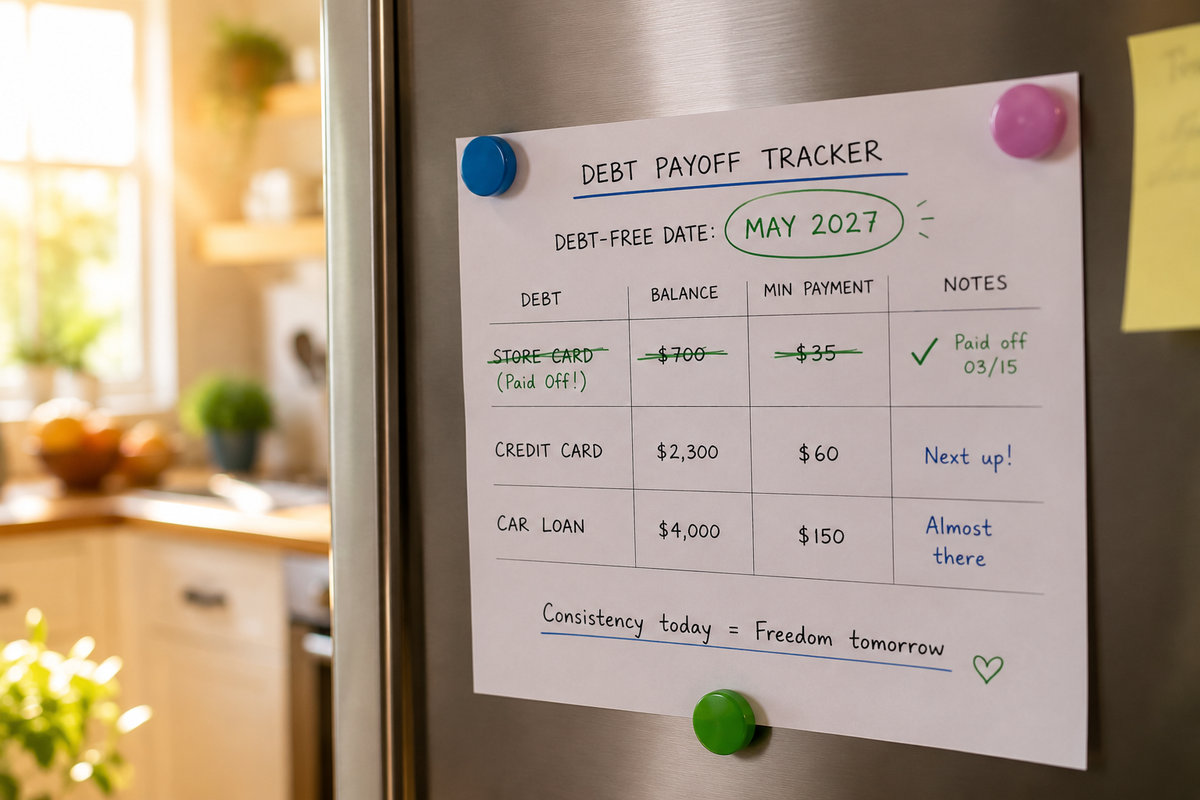
By now my snowball payment had grown to nearly $900 a month. All of it aimed at the $4,000 car loan, which had felt permanent at the start. It cleared in under five months. The final payment came in month eighteen, almost exactly when the tracker had predicted back on day one.

What I would do differently
Two things. First, I would build a small emergency buffer before starting. Twice during those eighteen months a surprise expense almost sent me back to a credit card. Only luck stopped me. A small cash cushion would have protected the whole plan.
Second, I would have started sooner. The hardest part was not the payments. It was the two years I spent avoiding the total before I wrote it down. The avoidance cost me far more than the interest ever did.
What actually made it work
Not willpower. Three boring things: a written list so I could not hide from the total, one small win early to prove the method worked, and a visible tracker so the progress never disappeared in my head. That is it.
If you are staring at your own pile of debts right now, wondering if it is even possible, it is. Start with the list. Open the free tracker. Put your numbers in. The rest follows.
See your own debt free date
Put your numbers into our free tracker and see the exact month you become debt free, a month by month plan, and how much interest you will save. Nothing is stored anywhere. Takes about five minutes.
Open the free tracker →Get the Debt Payoff Starter Kit
A printable debt tracker, a payoff worksheet, and a short 30-day guide. Sent free to your inbox.
No spam. Leave any time.
This article is for general information only and is not financial advice. See our full disclaimer.